
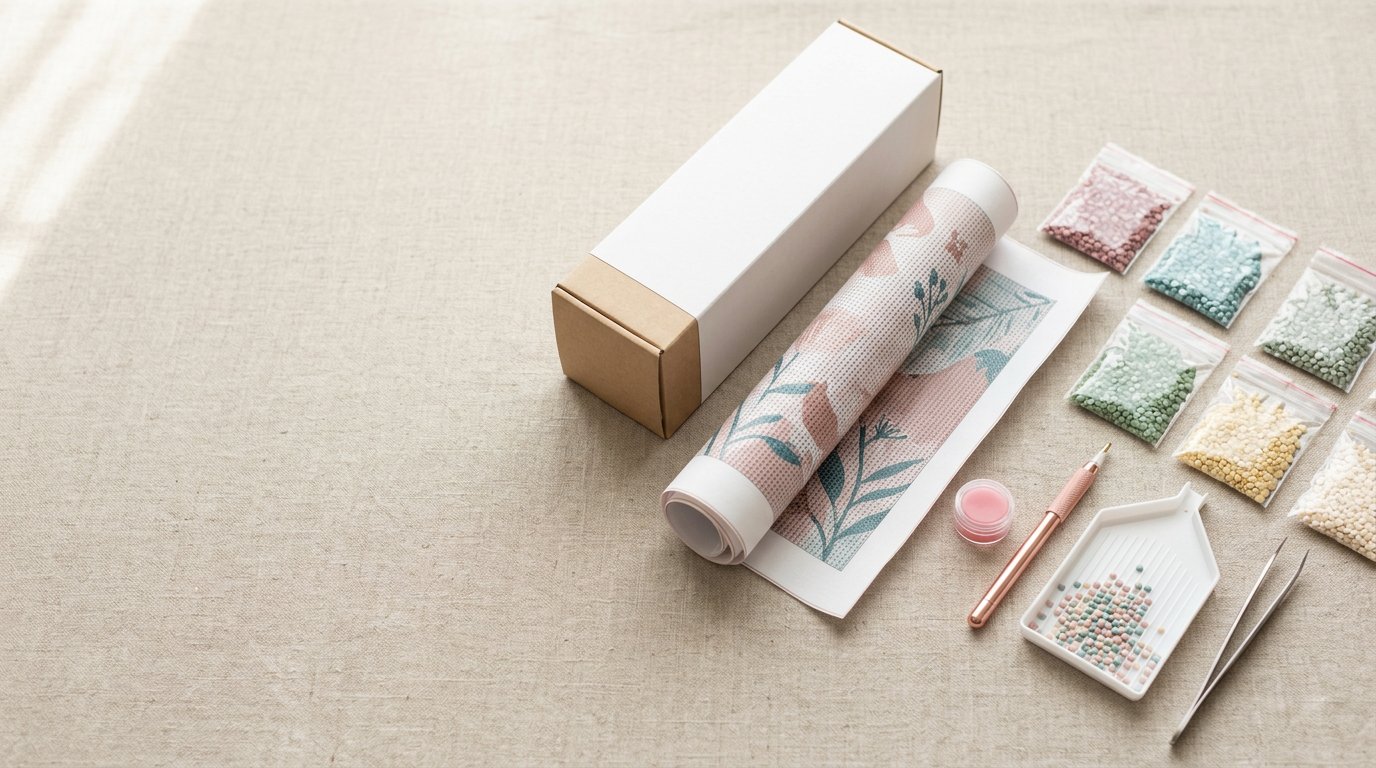
Private label diamond painting kits are complete diamond art kits manufactured by a third-party factory and sold under your own brand name. You own the brand, the artwork direction, the packaging and the customer relationship; the factory owns canvas printing, drill production, kitting and quality control. This guide covers what you can customize, the quality specs that drive repeat purchases, compliance and labeling, realistic unit economics, and a step-by-step path from first brief to production — written from the factory side of the table, where most private label projects succeed or quietly fall apart.
Key takeaways
- Private label sits between white label and full OEM. You get your own artwork, packaging and inserts on a proven product platform — far more differentiation than reselling generic kits, at a fraction of OEM development cost.
- MOQs are negotiable in two tiers: low minimums for existing catalog designs (often tens of units per design) and higher minimums for fully custom artwork and printed packaging (commonly 500–1,000+ units per design).
- Four specs drive reviews: resin (not acrylic) drills, consistent facet count, canvas adhesive that holds for years, and a drill overage clause in your purchase order.
- As the private labeler, you become the "manufacturer of record" for labeling purposes in the US — which means tracking labels, age grading and (for children's products) a Children's Product Certificate are your responsibility, not the factory's.
- A good first launch is 3–6 designs, not 30. Breadth comes after you know which artwork actually sells.
What "private label" actually means in diamond painting
In a private label arrangement, a manufacturer makes a product it already knows how to make, and you sell it under your own brand. In diamond painting, the platform is the kit: an adhesive, color-coded canvas; packs of resin "drills"; an applicator pen with wax; a sorting tray; tweezers; and printed instructions. What changes under private label is everything the customer can see and feel — the artwork, the box, the insert cards, the tool colors, the unboxing sequence.
That distinction matters because diamond painting is an unusually tactile product. Buyers judge it on things a product photo cannot show: whether the canvas is still tacky when they reach the bottom-right corner, whether the symbols are legible after an hour, whether the drills sparkle or look like dull plastic confetti. Those are all manufacturing decisions, which is why the most successful private label brands treat their factory as a product development partner rather than a vendor.
The anatomy of a kit you are branding
| Component | What it is | Branding opportunity |
|---|---|---|
| Canvas | Pre-printed adhesive canvas with a symbol chart; full drill (entire surface) or partial drill (subject only) | Artwork, size range, drill shape, symbol legibility, printed border or logo |
| Drills | Small faceted resin pieces, color-sorted and packed | Material, facet count, special finishes (AB, glow, iridescent), overage % |
| Tools | Applicator pen, wax pad, grooved tray, tweezers | Colorway, logo imprint, upgraded pen or light-up pen |
| Packaging | Rigid box, folding carton, kraft tube or mailer | Structural design, print finish, barcode/FNSKU placement |
| Paper inserts | Instruction sheet, color chart, thank-you card | Brand voice, care instructions, review request, cross-sell |
| Compliance labeling | Age grading, warnings, origin, batch code | Trust signals — and legal necessity |
Private label vs. white label vs. OEM vs. ODM
These four terms get used interchangeably in the industry, which is precisely why buyers end up with the wrong supply arrangement. Here is how they differ in practice.
| Model | Who designs the product | Branding | Typical MOQ | Best for |
|---|---|---|---|---|
| White label | Factory's existing catalog design | Your logo on standard packaging | Lowest — sometimes tens of units per design | Testing a channel fast, marketplaces, giveaways |
| Private label | Factory platform + your artwork and packaging spec | Fully your brand; kit presentation is custom | Moderate — commonly 100–500+ units per design | Building a real brand with differentiated artwork |
| OEM | You — the factory builds to your brief | Yours, to your exact specification | Higher | Brands with in-house design and tight spec control |
| ODM | Factory's design team, from your concept | Yours, on a factory-developed concept | Moderate to high | Brands with a concept but no design team |
The honest answer: almost every real project sits somewhere between private label and OEM. You will pick a proven kit format and then customize until it no longer resembles anything else on the shelf. That is the sweet spot — developed enough to defend a price premium, standardized enough to hit a sane cost and lead time.
Industry MOQ benchmarks vary widely by supplier; published examples include 60-piece minimums on catalog designs alongside 1,000-unit minimums for full custom private label packaging and proprietary artwork production[1]. Always confirm per-design minimums in writing, because "MOQ" can refer to the total order or to each individual design.
Why brands are moving to private label in 2026
Diamond painting demand itself is not in question. Category trackers estimate the global market anywhere from roughly US$220 million[2] to well over half a billion dollars[3], with growth forecasts ranging from about 5% to 12% CAGR. Those estimates disagree so much that we treat them as directional only. A more useful signal is marketplace behavior: industry tracking cited by DataM Intelligence estimated around 209,000 diamond art units sold across the top 50 Amazon US listings in a single month of 2026[4].
That is a lot of volume flowing through a channel where the same generic designs are sold by dozens of sellers at once. Which is exactly the problem private label solves:
- Price isolation. When your design exists nowhere else, there is no competing offer two rows below yours on the same listing.
- Artwork as an asset. A commissioned design library is intellectual property you can reprint, bundle and license. A catalog design is a commodity.
- Gift-channel access. Independent boutiques, museum shops and subscription boxes buy on presentation and story. Unbranded poly-mailer kits do not clear that bar.
- Repeat purchase. A recognizable brand with consistent quality converts a one-time kit buyer into a collector who watches for your next release.
- Control of the failure modes. The most common one-star reviews in this category — missing drills, illegible symbols, dried-out adhesive — are all specifiable.
What you can actually customize
Think of customization as a menu with three price tiers: paper (cheap, high impact), structure (moderate cost, high perceived value) and materials (highest cost, drives reviews).
| Layer | Options | Customer impact | Relative cost |
|---|---|---|---|
| Paper | Branded instruction sheet, thank-you card, color chart, brand story card, UPC/FNSKU label | High — this is the unboxing | Low |
| Structure | Rigid box vs. folding carton vs. kraft tube; insert tray; sleeve; hang tab | High — perceived value and shelf presence | Medium |
| Tools | Colorway, logo imprint, upgraded pen, metal tweezers, multi-placer heads | Medium | Low to medium |
| Materials | Resin vs. acrylic drills, facet count, specialty finishes, canvas weight and adhesive | Highest — determines reviews | High |
| Artwork | Your illustrations, licensed art, photo-to-canvas conversions, size and drill shape | Highest — determines whether it sells at all | Design time + plate fees |
Highest-ROI customization for a first launch
If budget is tight, spend it in this order: (1) original artwork, because it is the only thing a competitor cannot copy overnight; (2) a rigid printed box, because it justifies a premium price and survives shipping; (3) a branded insert card, because it is nearly free and drives reviews. Skip exotic drill finishes until you have reorder data.
The quality specs that decide whether customers reorder
Two kits can look identical in a listing photo and produce wildly different review averages. The difference is almost always in the specs below — and every one of them belongs in your written specification, not in a salesperson's promise.
| Spec | Entry-level | Better / premium | Why it matters |
|---|---|---|---|
| Drill material | Acrylic | Resin | Resin holds clarity and color; acrylic tends to dull and yellow over time in framed pieces[5] |
| Facet count | 9–13, sometimes mixed within one kit as molds degrade | Consistent 13–15 (square) / 15–20 (round) | More facets reflect more light; consistency prevents patchy sparkle across a finished piece[5] |
| Drill size | Varies | ~2.5 mm square, ~2.8 mm round (specify it) | Standard sizes keep replacement drills and tools compatible[6] |
| Drill shape | Round | Round for ease, square for detail | Round drills are faster and more forgiving with a softer sparkle; square drills tile edge-to-edge for a crisp, gap-free finish that suits portraits and architecture[7] |
| Canvas adhesive | Thin glue, paper cover | High-tack, low-odor adhesive with protective film | Adhesive is the single biggest driver of long-term satisfaction — a piece that loses drills after six months on the wall earns a permanent one-star review |
| Symbol legibility | Dense symbols under dark drills | High-contrast symbols, larger canvas per design | Illegible charts are the top complaint on large, high-color-count designs |
| Drill overage | Undisclosed | Stated % in the PO (commonly 10–30%) | Running out of one color mid-project is the most avoidable bad review in the category |
| Color count | 15–25 | 30–60+ | More colors = smoother gradients and finer detail, but slower production and more packing labor |
The clause most first-time buyers forget
Put a drill overage and shortage tolerance in your purchase order — for example, "each color packed with a minimum 15% surplus; shortages above 1% of kits per batch to be replaced free of charge." Without it, a per-bag weight tolerance that seems trivial at the factory becomes several hundred angry customers for you.
Compliance and labeling: the part that stops shipments
This is the least glamorous section of this guide and the one most likely to cost you real money. Requirements depend on where you sell and who you sell to, so treat the table below as a briefing checklist for your compliance advisor and importer of record — not as legal advice.
| Market | What to confirm before production |
|---|---|
| United States — general art materials | Your product must carry the conformance statement "Conforms to ASTM D-4236" (the standard is codified in federal regulation at 16 CFR 1500.14(b)(8)) and any precautionary labeling a toxicologist's review requires[8] |
| United States — children's products (12 and under) | Third-party testing by a CPSC-accepted lab, a Children's Product Certificate, and a permanent tracking label bearing the manufacturer or private labeler name, location and date of manufacture, and batch or run number[8] |
| European Union / United Kingdom | Confirm current toy-safety and general product safety requirements (EN 71 testing where the product is a toy, CE/UKCA marking, technical documentation, and an identified responsible person or importer) with your importer of record |
| Marketplaces (Amazon FBA, Walmart, Etsy) | Scannable FNSKU or UPC per SKU, polybag suffocation warnings where applicable, country-of-origin marking, and carton labeling that matches your inbound plan |
| Retail chains | Vendor-specific packaging and labeling standards, plus test-report submissions — ask for the manual before you finalize artwork |
You are the "private labeler" of record
This surprises a lot of first-time buyers. Under CPSIA tracking-label rules, the label must identify the manufacturer or private labeler — so when you put your brand on the box, your name goes on the tracking label[8]. Tell your factory which name, address and batch-code format to print, and confirm it on the golden sample rather than discovering it after 2,000 units are packed.
Unit economics: a worked, illustrative example
Private label only works if the arithmetic works. Here is a build-up for a hypothetical mid-size kit sold on a marketplace at US$24.99. These figures are illustrative only — factory pricing, freight and marketplace fees move constantly. Use the structure, get real numbers from a quote.
| Line item | Illustrative cost | Notes |
|---|---|---|
| FOB unit cost (kit + custom printed box) | $2.80 | Falls with volume and with simpler packaging |
| Sea freight, duty and inland delivery (amortized) | $0.70 | Air freight can triple this line |
| Inbound prep and labeling | $0.25 | Higher if you need polybagging or kitting |
| Landed cost per unit | $3.75 | Your true product cost |
| Marketplace referral fee (~15%) | $3.75 | Percentage of the $24.99 sale price |
| Fulfillment fee (~1 lb craft kit) | $6.00 | Weight and dimensions driven — box design matters here |
| Total cost before advertising | $13.50 | |
| Gross profit before ads | $11.49 (46%) | |
| Advertising at 20% of revenue | $5.00 | Typical range for a competitive craft keyword |
| Net contribution per unit | $6.49 (26%) | Before returns, storage and overhead |
Three levers dominate that model, and only one of them is the unit price:
- Packaging dimensions. A box that crosses a fulfillment weight or size tier can cost you more than a $0.30 saving on drills. Design packaging to the fee table, not just to the shelf.
- Conversion rate. Original artwork and better photography lift conversion, which lowers your effective ad cost per sale — the largest line in the model.
- Return rate. Resin drills, strong adhesive and a stated overage percentage are cheap insurance against the refund requests that quietly erase a 26% margin.
From brief to first production run: a 7-step workflow
1. Define the promise
Decide who the brand serves before you pick artwork: mindful adults, kids and families, pet portrait gifts, seasonal décor? The answer determines canvas sizes, drill shape, difficulty level and price point.
2. Build a tight SKU matrix
Three to six designs for a first launch. A useful spread: two accessible bestsellers (30×40 cm, round drills), two statement pieces (50×70 cm, square drills) and one or two seasonal or gift-led designs.
3. Secure the artwork rights
Only use artwork you own or are licensed to reproduce. Send print-ready files — vector or high-resolution raster — and ask your factory's designer for a color-mapped proof, not just a preview.
4. Specify the kit in writing
One page per SKU: canvas size, drill shape and material, facet count, color count, overage percentage, tool list, packaging structure, insert list, labeling text. Vague specs are the number one cause of disappointing samples.
5. Lock compliance and labeling
Confirm the conformance statement, age grading, origin marking, tracking-label format and barcode/FNSKU placement while artwork is still editable.
6. Approve a golden sample
Evaluate the sample the way a customer will: complete at least a corner of it. Check tack, symbol legibility, drill consistency and count the worst-case color. Sign and retain the approved sample as your reference for production QC.
7. Produce, inspect, ship
Agree the inspection standard and who pays for rework before the PO is signed. Typical production lead times in this category run roughly 7–15 days once artwork and specs are confirmed, with freight transit separate — and Q4 capacity books up early, so plan seasonal inventory backwards from your in-stock date, not from your order date.
What to send in your first RFQ (gets you an accurate quote faster)
- Artwork files or a clear concept, and confirmation you hold the rights
- Quantity per design and total, plus target launch date and destination
- Canvas sizes, drill shape (round/square) and full vs. partial drill
- Packaging style and whether you need custom inserts and tools
- Sales channel (marketplace, retail, own store, dropshipping) — this drives labeling requirements
- Compliance documents you already hold, and any the factory should provide
How to vet a private label manufacturer: 12 questions
- Do you own the factory, or are you trading? Ask for production-line photos or a live video walkthrough.
- Is design support in-house? A real designer shortens the artwork-to-proof cycle dramatically.
- Where do the drills come from? Molded in-house, or bought in? In-house molding means better facet-count consistency.
- What is the MOQ per design, not just per order?
- How many rounds of samples are included, and what do they cost?
- What is your QC process and AQL standard? Ask how shortages and mispacks are handled.
- Can you provide test reports and compliance documentation for my market?
- What is the production lead time, and what happens in peak season?
- What are the shipping terms? Confirm Incoterms (FOB, EXW, DDP) and the named port.
- Will you sign an NDA, and how is my artwork handled after the order?
- Can you share references from brands selling in my channel?
- What is the reprint policy for a defective batch? Get it in writing.
Six mistakes that sink first private label runs
- Buying on unit price alone. A $0.40 saving on acrylic drills can cost you a full star of review average.
- Skipping the golden sample or approving it from photos instead of completing part of the canvas by hand.
- No overage clause — then discovering a shortage at scale.
- Ambiguous artwork rights. Converting a photographer's image or a fan-art character into a kit is a legal problem, not a design problem.
- Launching 30 designs at once. You will learn more from six, and you will not be stuck with 24 slow movers.
- Ordering in September for a December launch. Build the calendar backwards from the date stock must be live.
Ready to spec your first kit?
Diamond Paintings Art is a diamond painting kit manufacturer with its own factory, in-house design support and flexible B2B supply — wholesale, OEM, ODM, private label, white label and dropshipping, FOB Xiamen with typical 7–15 day production. Send your artwork or concept, target quantity, packaging needs and destination, and we will prepare a project-specific quotation.
Frequently asked questions
What is the difference between private label and white label diamond painting kits?
White label means you put your logo on a factory's existing catalog kit with standard packaging — fastest and cheapest, with almost no differentiation. Private label means the kit is built around your artwork, packaging and inserts, so the product itself is yours even though the manufacturing platform is shared. If you are building a brand rather than testing a listing, private label is almost always the better choice.
What is a typical MOQ for private label diamond painting kits?
It depends on how much is custom. Existing catalog designs can carry very low minimums — sometimes tens of units per design — while fully custom artwork with printed custom packaging commonly starts in the hundreds to low thousands of units per design, because printing plates and setup costs must be amortized. Always confirm whether the MOQ applies per design or to the total order; those are very different numbers.
How much does it cost to launch a private label diamond painting line?
Budget for four buckets: unit cost (landed), packaging and print setup, sampling, and compliance testing if your market requires it. A focused first run of three to six designs is usually a four-figure to low five-figure investment depending on quantity and packaging. The bigger risk is not the initial spend but slow-moving inventory, which is why a small, well-chosen first range beats a large speculative one.
How long does production take?
Once artwork, specifications and packaging are confirmed, typical production lead times in this category run about 7–15 days, with freight transit counted separately. The calendar is usually dominated by the steps before production — artwork development, sampling and revisions — not by the manufacturing itself.
Can I use my own artwork, or customers' photos?
Yes, provided you own the artwork or are authorized to reproduce it. Most factories can map a photo or illustration into a color-coded canvas design. For custom-photo programs sold to consumers, ask your factory about a per-unit custom workflow and the associated lead time, since custom kits produced one at a time behave very differently from bulk production.
Should my first line use round or square drills?
Lead with round drills if your buyers are beginners or if your designs are florals and abstracts — round drills are faster and more forgiving, with a softer sparkle. Choose square drills for portraits, pets, architecture and any artwork where fine detail matters, because square drills tile edge-to-edge with no gaps. Many brands launch with both and let sales data decide the next range.
Do I need safety testing for diamond painting kits?
For the US market, art materials require an ASTM D-4236 conformance statement, and kits intended for children 12 and under additionally require third-party testing by a CPSC-accepted lab, a Children's Product Certificate and a permanent tracking label. Requirements differ by market, so confirm the rules for your destination with your compliance advisor and importer of record before you finalize packaging artwork.
Can a factory support Amazon FBA and dropshipping?
Many can, including FNSKU or barcode labeling per unit and carton labeling to match your inbound plan — but you must ask, because it changes how the packing line is set up. For dropshipping, confirm destination coverage, per-order handling and packaging that survives parcel transit without arriving crushed.
How do I stop a factory from reselling my design?
There is no substitute for a signed NDA plus a written agreement covering artwork ownership, mold and printing-plate ownership, and whether the design may be produced for anyone else. Commercially, the strongest protection is a relationship worth more than the design: suppliers with long-term brand programs have little incentive to risk them.
The bottom line
Private label is the shortest path from "I want to sell diamond painting kits" to "I own a diamond painting brand." It buys you differentiation that generic sourcing cannot, at a fraction of full OEM development cost — provided you do the unglamorous work: write a real specification, demand a golden sample you actually complete, put an overage clause in the PO, and settle compliance before the artwork is locked.
Start with three to six designs you genuinely believe in. Let the reviews and the reorder data tell you what to launch next. That is how private label lines turn into brands.
Request a project-specific quote → Send your artwork or idea, target quantity, packaging needs and destination, and our team will review your brief.
References
[1] Global Growth Insights — Diamond Painting Market report. globalgrowthinsights.com
[2] Market Research Intellect — Diamond Painting Market size and forecast. marketresearchintellect.com
[3] DataM Intelligence, via OpenPR — Diamond Art Painting Market, US marketplace volume estimates. openpr.com
[4] U.S. Consumer Product Safety Commission — Art Materials Business Guidance (ASTM D-4236, CPSIA, tracking labels). cpsc.gov
Note: market figures are third-party estimates and vary substantially between research firms; treat them as directional. Compliance information is general guidance — confirm current requirements for your destination market with a qualified advisor.